NOTES ON "LIFE PROCESS" BY-NAGRAJ SIR
NOTES ON "LIFE PROCESS" BY-NAGRAJ SIR
Basic life processes are : Nutrition, Respiration, Transportation, Excretion, Reproduction etc.
Life Processes require energy which is provided by nutrition.
- Nutrition: The process by which an organism takes food and utilizes it, is called nutrition.
- Need for Nutrition: Organisms need the energy to perform various activities. The energy is supplied by the nutrients. Organisms need various raw materials for growth and repair. These raw materials are provided by nutrients.
- Nutrients: Materials which provide nutrition to organisms are called nutrients. Carbohydrates, proteins and fats are the main nutrients and are called macronutrients. Minerals and vitamins are required in small amounts and hence are called micronutrients.
- Modes of Nutrition
1. Autotrophic Nutrition.
2. Heterotrophic Nutrition.
Modes of Nutrition
- Autotrophic :-Kind of nutrition in which organisms can synthesize their own food Eg. Green Plants
- Heterotrophic:- Kind of nutrition of which organisms do not possess the ability to synthesize their own food. They depend on autotrophs for their food supply directly or indirectly. Eg. Animals, Fungi
Autotrophic Nutrition
- Autotrophs : The organisms which can make their own food are called autotrophs (green plants).
- Photosynthesis : The process by which green plants make their own food with the help of CO
and H
- Raw Materials for Photosynthesis :
- Site of Photosynthesis : Chloroplast in the leaf. Chloroplast contain chlorophyll. (green pigment).
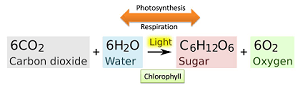
- Main Events of Photosynthesis
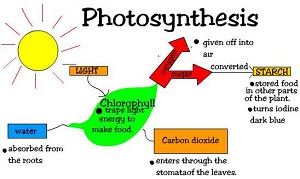
Absorption of Sunlight energy by chlorophyll
to carbohydrates.
- Stomata : Tiny pores present on the surface of the leaves.
- Functions of Stomata
- (i) Exchange of gases
- (ii) Loses large amount of water [water vapour] during transpiration and helps in up flow of water
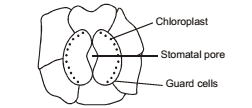
Chloroplast contains the green pigment chlorophyll which has a pivotal role in photosynthesis.
Heterotrophic Nutrition – Life Processes Class 10 Notes
The mode of nutrition in which an organism takes food from another organism is called heterotrophic nutrition. Organisms, other than green plants and blue-green algae follow the heterotrophic mode of nutrition. Heterotrophic nutrition can be further divided into three types, viz. saprophytic , holozoic, and parasitic.
- Saprophytic Nutrition: In saprophytic nutrition, the organism secretes the digestive juices on the food. The food is digested while it is still to be ingested. The digested food is then ingested by the organism. All the decomposers follow saprophytic nutrition. Some insects, like houseflies, also follow this mode of nutrition.
- Holozoic Nutrition: In holozoic nutrition, the digestion happens inside the body of the organism. i.e., after the food is ingested. Most of the animals follow this mode of nutrition.
- Parasitic Nutrition: The organism which lives inside or outside another organism (host) and derives nutrition from it is known as parasites and this type of mode of nutrition is called parasitic nutrition. For example Cuscuta, tick etc.
Nutrition in Amoeba
- Amoeba is a unicellular animal which follows the holozoic mode of nutrition.
- In holozoic nutrition, the digestion of food follows after the ingestion of food. Thus, digestion takes place inside the body of the organism.
- Holozoic nutrition happens in five steps, viz. ingestion, digestion, absorption, assimilation and egestion.


- Ingestion: The process of taking in the food is called ingestion.
- Digestion: The process of breaking complex food substances into simple molecules is called digestion. Simple molecules, thus obtained, can be absorbed by the body.
- Absorption: The process of absorption of digested food is called absorption.
- Assimilation: The process of utilization of digested food, for energy and for growth and repair is called assimilation.
- Egestion: The process of removing undigested food from the body is called egestion.
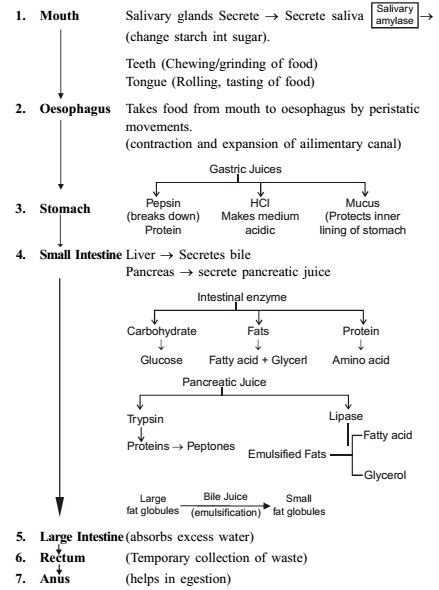
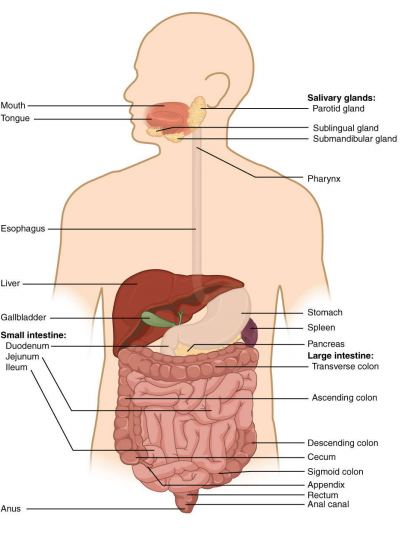
- Nutrition in Human Beings : The human digestive system comprises of alimentary canal and associated digestive glands.
HUMAN DIGESTIVE SYSTEM
Respiration
It is a process in living organisms involving the production of energy, typically with the intake of oxygen and the release of carbon dioxide from the oxidation of complex organic substances.
(i) Gaseous exchange : Intake of oxygen from the atmosphere and release of carbondioxide.
(ii) Breakdown of simple food in order to release energy inside the CellularRespiration
- Breakdown of Glucose by various pathways
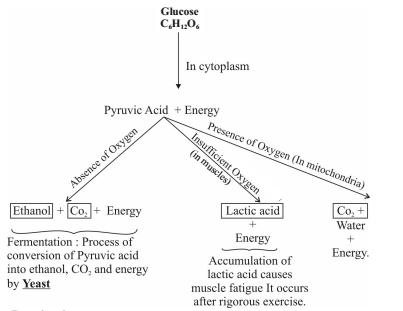
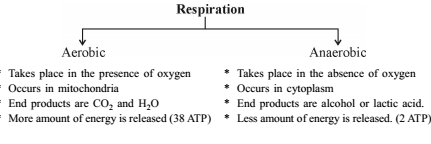
- Respiration
- Human Respiratory System : Passage of air through the respiratory system.
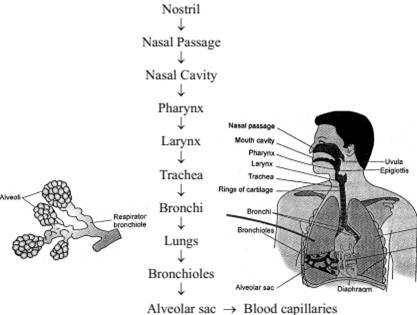
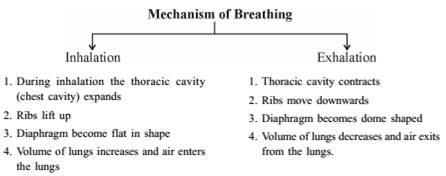
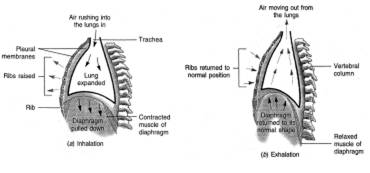
- Mechanism of Breathing
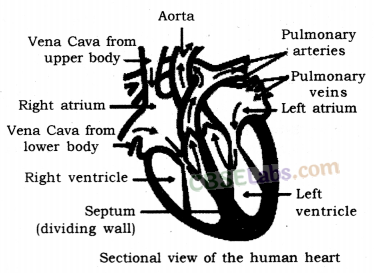

Heart: Heart is a muscular organ, which is composed of cardiac muscles.
- It is so small that, it can fit inside an adult’s wrist. The heart is a pumping organ which pumps the blood.
- The human heart is composed of four chambers, viz. right atrium, right ventricle, left ventricle and left atrium.
- Systole: Contraction of cardiac muscles is called systole.
- Diastole: Relaxation of cardiac muscles is called diastole.
- .
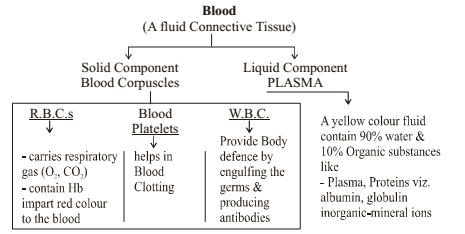
- Lymph – a yellowish fluid that escapes from the blood capillaries into the intercellular spaces. Lymph flows from the tissues to the heart assisting in transportation and destroying germs.
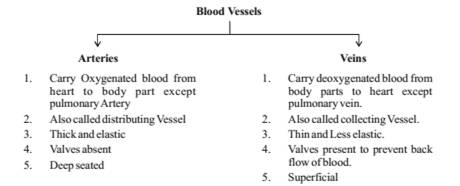
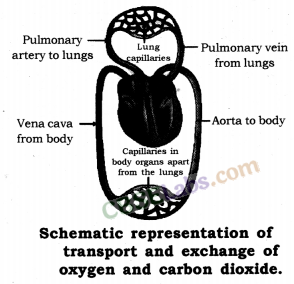
Double circulation: In the human heart, blood passes through the heart twice in one cardiac cycle. This type of circulation is called double circulation. One complete heartbeat in which all the chambers of the heart contract and relax once is called cardiac cycle. The heart beats about 72 times per minute in a normal adult. In one cardiac cycle, the heart pumps out 70 mL blood and thus, about 4900 mL blood in a minute. Double circulation ensures complete segregation of oxygenated and deoxygenated blood which is necessary for optimum energy production in warm-blooded animals.
Transportation in plants: Plants have specialized vascular tissues for transportation of substances. There are two types of vascular tissues in plants.
- Xylem: Xylem is responsible for transportation of water and minerals. It is composed of trachids, xylem vessels, xylem parenchyma and xylem fibre. Tracheids and xylem vessels are the conducting elements. The xylem makes a continuous tube in plants which runs from roots to stem and right up to the veins of leaves.
- Carry water and minerals from the leaves to the other part of the plant.
- Phloem: Phloem is responsible for transportation of food. Phloem is composed of sieve tubes, companion cells, phloem parenchyma and bast fibers. Sieve tubes are the conducting elements in phloem.
Ascent of sap: The upward movement of water and minerals from roots to different plant parts is called ascent of sap. Many factors are at play in ascent of sap and it takes place in many steps. They are explained as follows :
- Root pressure: The walls of cells of root hairs are very thin. Water from soil enters the root hairs because of osmosis. Root pressure is responsible for movement of water up to the base of the stem.
- Transpiration pull: Loss of water vapour through stomata and lenticels, in plants, is called transpiration. Transpiration through stomata creates vacuum which creates a suction, called transpiration pull. The transpiration pull sucks the water column from the xylem tubes and thus, water is able to rise to great heights in even the tallest plants.
- Transport of food: Transport of food in plants happens because of utilization of energy. Thus, unlike the transport through xylem, it is a form of active transport. Moreover, the flow of substances through phloem takes place in both directions, i.e., it is a two-way traffic in phloem.
- Transpiration is the process of loss of water as vapour from aerial parts of the plant.
Excretion in human beings : The process of the removal of the harmful metabolic wastes from the body is called excretion. Excretory system of human beings includes :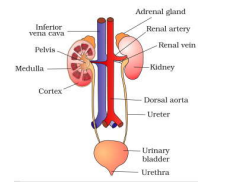
Nephron : Each kidney has a large number of filtration units called nephrons.
Nephron is the structural and functional unit of Kidney.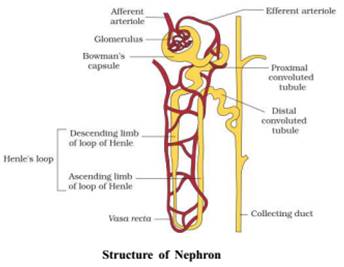
Mechanism of Urine Formation : The Urine formation involves three steps:
- Glomerular Filtration : Blood is filtered from the glomerulus into Bowman Capsule of the nephron. This filtrate passes through the tubules of the nephron.
- Tubular re-absorption : Now, useful substances from the filtrate Like
, glucose, amino acids etc. are reabsorbed by the capillaries surrounding the nephron into the blood.
- Secretion : Urea, extra water and salts are secreted into the tubule which open up into the collecting duct & then into the ureter.
The purpose of making urine is to filter out waste product from the blood i.e., urea which is produced in the liver.
- Haemodialysis: The process of purifying blood by an artificial kidney. It is meant for Kidney failure patient.
